
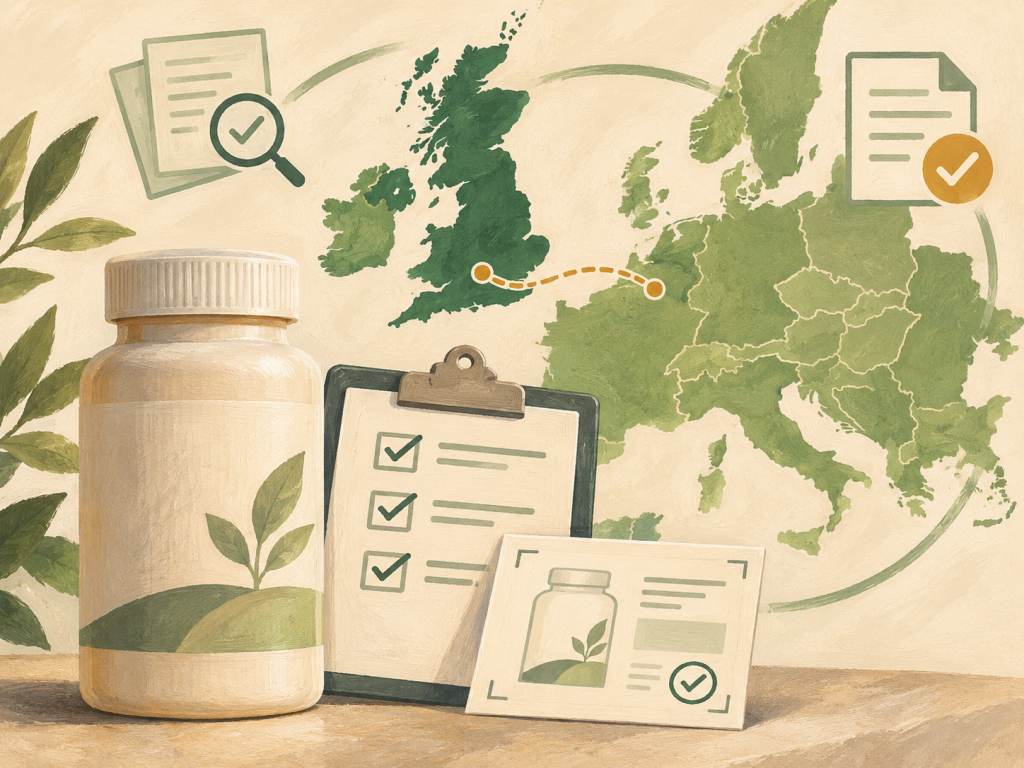
Why a compliant product in one country may not automatically be market-ready in another.
A supplement can be lawfully sold in one country and still encounter regulatory barriers in another. That is not necessarily because one authority considers the product unsafe. The difficulty may arise from differences in national requirements, ingredient restrictions, notification procedures, labelling, language or the regulatory status of a particular preparation.
For businesses planning a pan-European launch, the central question should therefore be “Which markets has this particular product actually been assessed for?” rather than simply “Is this an EU-compliant supplement?”
One European market does not mean one complete supplement rulebook
Directive 2002/46/EC harmonises important aspects of food supplement legislation in the EU, particularly permitted vitamins and minerals, their sources and supplement-specific labelling. But it does not create a fully harmonised framework for every botanical, amino acid or other substance used in supplements. Member States retain significant national requirements in certain areas.
General legislation on food safety, novel foods, additives, food information and nutrition and health claims adds further obligations. A product may comply with the Food Supplements Directive but fail a different applicable rule. A formulation review therefore cannot stop at the list of vitamins or minerals.
Great Britain, Northern Ireland and the EU: three questions, not one
Great Britain comprises England, Scotland and Wales. Following Brexit, GB operates its own amended food law framework, with relevant powers, registers and authorisation decisions separate from those of the EU.
Northern Ireland has a distinct position under the Windsor Framework. Relevant EU food legislation continues to apply there, alongside the applicable UK domestic provisions and market-access arrangements. Businesses should not automatically treat a GB-only compliance decision as sufficient for Northern Ireland.
The EU applies harmonised legislation where it exists, but national provisions still matter. Ireland, for example, has a food supplement notification requirement. Other Member States may impose different procedures, restrictions or presentation rules. A product intended for several EU countries should be checked individually against those destinations.
Where do problems commonly arise?
Ingredient identity and national restrictions
Suppose a supplement contains a botanical extract. Its Latin name may be familiar, but that does not establish that the exact plant part, extract, solvent, concentration and daily intake are acceptable in each country. National controls and medicinal-product considerations can matter. Likewise, a nutrient source permitted in GB should be checked against the current EU list and any relevant national provisions before assuming mutual marketability.
Novel foods
A food or ingredient with an EU novel food authorisation must comply with its precise specifications, conditions of use and labelling. A GB authorisation is a different legal instrument, and the two systems have made separate decisions since Brexit. Conversely, the absence of a food from the European Commission’s Novel Food status Catalogue does not itself prove non-novel status: the Catalogue is expressly non-binding and non-exhaustive.
Claims and online marketing
Regulation (EC) No 1924/2006 provides the core EU structure for nutrition and health claims, with a separate GB system following Brexit. Authorised wording, conditions of use and restrictions need checking for each target market. A product may have acceptable ingredients and physical labelling but an unlawful website claim. Translating an English claim into another language does not remove the need to check how consumers in the target country understand it.
Labelling and the responsible business
General food information rules sit alongside supplement-specific labelling obligations. Required languages, the responsible food business operator or importer address, quantitative declarations, warnings and presentation requirements must be assessed for each destination. GB and EU/NI address requirements have differed since Brexit. The proposed UK–EU SPS Agreement may change some of these requirements in future, but businesses must use the legal position in force when placing food on the market.
Notification is not product approval
Some EU countries require food supplement notifications. Ireland, for instance, requires notification to the Food Safety Authority of Ireland when a supplement is first placed on the market, subject to its applicable rules and responsibility arrangements. A successful notification is not a blanket approval confirming composition, safety and claims compliance, and it does not automatically cover other countries.
A market-entry matrix is more useful than a generic certificate
A practical assessment records the individual markets and the specific questions answered for each of them:
| Review area | Question to document |
|---|---|
| Product category | Is it a food supplement in the intended market, or could another classification apply? |
| Ingredient permissions | Are all nutrients, sources, botanicals and other substances acceptable for their intended use? |
| Novel food status | Is each relevant ingredient non-novel or authorised for the proposed use? |
| Composition and safety | Is the daily intake suitable, and do relevant national restrictions apply? |
| Labelling | Are all mandatory particulars, warnings, languages and address requirements satisfied? |
| Claims | Are promotional statements permitted and their conditions fulfilled? |
| Notifications and imports | Are any national notifications, import formalities or operational requirements applicable? |
This record supports a more reliable launch decision than a supplier statement claiming that a product is simply “EU compliant”.
What about mutual recognition?
Within the EU, mutual recognition can be relevant to certain non-harmonised goods lawfully marketed in another Member State, but its operation is qualified and must be considered against applicable EU measures and national public-interest restrictions. It is not a general exemption from harmonised food law, notification duties, novel food authorisation or medicinal-product controls. Businesses should avoid treating mutual recognition as a substitute for market-specific assessment.
The proposed UK–EU SPS Agreement
The UK and EU are negotiating a sanitary and phytosanitary agreement intended to align relevant rules and reduce agrifood trade friction. As at 30 October 2026, it is not yet in force. The government is aiming for implementation in mid-2027, subject to negotiations. If implemented as envisaged, it could reduce some GB/EU differences, including certain food information and regulated-product authorisation requirements. It would not automatically harmonise every national food supplement rule across EU Member States.
Conclusion
A food supplement’s legal status is not a passport stamped “UK and EU”. It is the outcome of an assessment against the rules of its actual destination markets. For an early-stage brand, this means choosing intended markets before fixing the formulation and packaging. For an established company, it means maintaining a jurisdiction-specific record of the evidence supporting every product it distributes.
Official sources
- European Commission: Food supplements and EU framework
- Directive 2002/46/EC on food supplements
- UK government food supplement guidance
- Food Safety Authority of Ireland: Food supplement legislation and notification
- European Commission Novel Food status Catalogue
- UK government SPS business-readiness guidance